
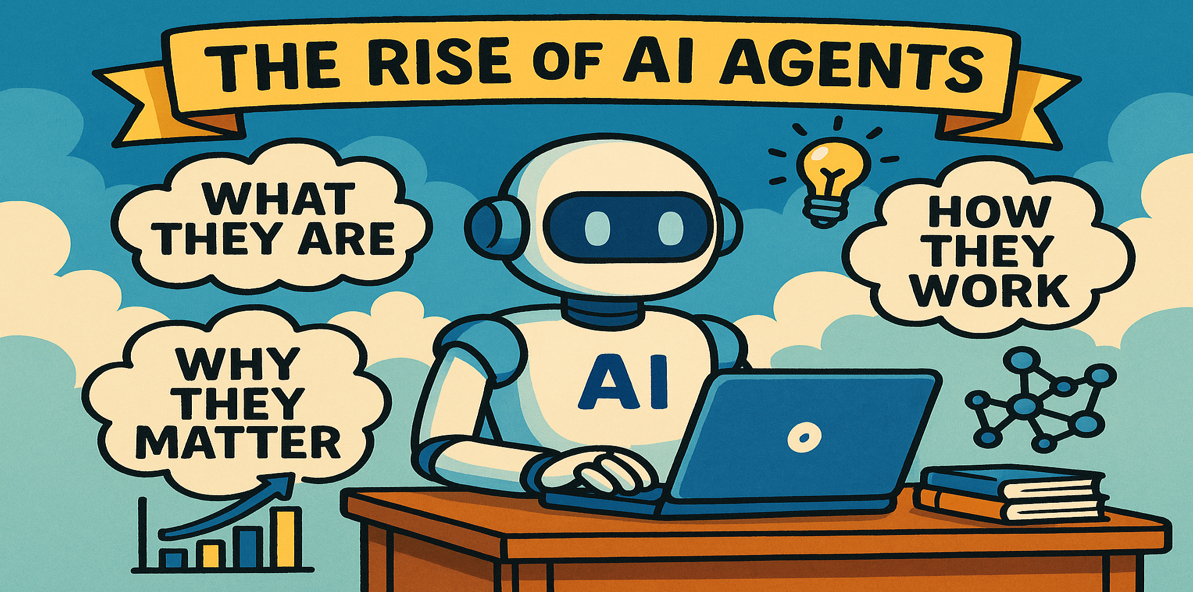
In recent years, Artificial Intelligence (AI) has evolved from a futuristic concept into a transformative force across industries. Among the most exciting developments is the emergence of AI agents—autonomous systems capable of performing tasks, making decisions, and interacting with users or environments with minimal human intervention. As businesses and individuals increasingly adopt these technologies, understanding what AI agents are and why they matter has become essential.
What Are AI Agents?
At their core, AI agents are software programs designed to perceive, decide, and act in order to achieve specific goals. Unlike traditional software that follows fixed instructions, AI agents can learn from data, adapt to changing conditions, and operate independently.
An AI agent typically consists of three main components:
- Perception: Gathering data from the environment (e.g., user input, sensors, or databases)
- Decision-making: Processing information using algorithms or machine learning models
- Action: Executing tasks or providing outputs based on decisions
For example, a virtual assistant that schedules meetings, responds to emails, and learns user preferences is a simple form of an AI agent. More advanced agents can manage workflows, trade stocks, or even control autonomous vehicles.
Types of AI Agents
AI agents come in various forms depending on their complexity and use cases. Here are the most common types:
1. Reactive Agents
These agents respond to immediate inputs without storing past experiences. They are fast and efficient but limited in adaptability.
2. Model-Based Agents
These agents maintain an internal model of the world, allowing them to make better decisions based on context and history.
3. Goal-Based Agents
Goal-based agents act to achieve specific objectives, evaluating multiple possible actions to determine the best path forward.
4. Learning Agents
These are the most advanced type. Learning agents improve over time by analyzing data and outcomes, becoming more efficient and accurate with experience.
Key Technologies Behind AI Agents
The rise of AI agents is powered by several cutting-edge technologies:
Machine Learning (ML)
Machine learning enables AI agents to learn from data and improve performance without explicit programming.
Natural Language Processing (NLP)
NLP allows agents to understand and respond to human language, making interactions more natural and intuitive.
Reinforcement Learning
This technique allows agents to learn through trial and error, optimizing decisions based on rewards and penalties.
Automation and APIs
Modern AI agents integrate with tools and systems through APIs, enabling them to perform complex, multi-step tasks across platforms.
Why AI Agents Matter
The growing importance of AI agents lies in their ability to transform how work is done. Here’s why they are becoming indispensable:
1. Increased Productivity
AI agents can handle repetitive tasks such as data entry, scheduling, and customer support. This allows humans to focus on higher-value activities like strategy and creativity.
2. 24/7 Availability
Unlike human workers, AI agents can operate around the clock, providing continuous service and support without downtime.
3. Cost Efficiency
By automating processes, businesses can reduce operational costs and improve efficiency at scale.
4. Enhanced Decision-Making
AI agents analyze large volumes of data quickly, offering insights that help organizations make better, data-driven decisions.
5. Personalization at Scale
From e-commerce recommendations to personalized marketing, AI agents enable tailored user experiences for millions of users simultaneously.
Real-World Applications of AI Agents
AI agents are already being used across various industries:
1. Customer Service
Chatbots and virtual assistants handle inquiries, resolve issues, and improve customer satisfaction.
2. Healthcare
AI agents assist in diagnostics, patient monitoring, and treatment recommendations, enhancing medical outcomes.
3. Finance
In finance, AI agents detect fraud, manage portfolios, and automate trading strategies.
4. E-commerce
Online retailers use AI agents for product recommendations, inventory management, and dynamic pricing.
5. Smart Homes and IoT
AI-powered devices control lighting, security, and energy usage, making homes more efficient and convenient.
Challenges and Risks of AI Agents
Despite their benefits, AI agents also present several challenges:
1. Ethical Concerns
Issues such as bias, privacy, and transparency must be addressed to ensure responsible AI usage.
2. Security Risks
Autonomous systems can be vulnerable to cyberattacks if not properly secured.
3. Job Displacement
Automation may replace certain jobs, requiring workforce reskilling and adaptation.
4. Dependence on Data
AI agents rely heavily on data quality. Poor or biased data can lead to inaccurate decisions.
The Future of AI Agents
The future of AI agents is incredibly promising. As technology advances, we can expect:
- More autonomous systems capable of handling complex, multi-step tasks
- Improved human-AI collaboration, where agents act as intelligent assistants
- Greater integration across industries, from education to logistics
- Smarter personal AI companions that understand user needs deeply
Emerging trends like agentic AI—where multiple AI agents collaborate to achieve goals—are pushing the boundaries even further.
How Businesses Can Leverage AI Agents
To stay competitive, businesses should consider the following strategies:
1. Identify Automation Opportunities
Analyze workflows to find repetitive or time-consuming tasks that AI agents can handle.
2. Invest in AI Infrastructure
Adopt tools and platforms that support AI integration and scalability.
3. Focus on Data Quality
Ensure data is clean, accurate, and unbiased to maximize AI performance.
4. Train the Workforce
Upskill employees to work alongside AI systems effectively.
Conclusion
The rise of AI agents marks a significant shift in how technology interacts with the world. These intelligent systems are not just tools—they are active participants in decision-making and task execution. From boosting productivity to enabling personalized experiences, AI agents are reshaping industries and redefining the future of work.
As adoption continues to grow, understanding what AI agents are and why they matter will be crucial for individuals and organizations alike. Those who embrace this transformation early will be better positioned to thrive in an increasingly AI-driven world.