
Artificial Intelligence (AI) is no longer a futuristic concept—it is a powerful force shaping industries, economies, and everyday life. As we move deeper into 2026, AI continues to evolve at an unprecedented pace, transforming how businesses operate and how humans interact with technology. In this article, we explore the top AI trends in 2026, providing a comprehensive, SEO-optimized guide to understanding the future of artificial intelligence.
1. Agentic AI: The Rise of Autonomous Decision-Making Systems
One of the most significant AI trends in 2026 is the emergence of Agentic AI—systems capable of acting independently to achieve goals without constant human supervision. These AI agents can plan, execute, and adapt tasks in real time.
Businesses are increasingly deploying agentic systems for:
- Customer service automation
- Supply chain optimization
- Personal productivity assistants
Unlike traditional AI, which requires prompts or instructions, agentic AI can initiate actions proactively, making it a game-changer for enterprise operations.
2. Multimodal AI: Beyond Text-Based Intelligence
Multimodal AI is redefining how machines understand and process information. Instead of relying solely on text, AI systems now integrate:
- Images
- Audio
- Video
- Sensor data
In 2026, multimodal AI powers advanced applications such as:
- Real-time video analysis
- Voice-enabled assistants with emotional intelligence
- AI-driven content creation tools
This trend is making AI more human-like and context-aware, enabling richer and more intuitive interactions.
3. Generative AI Evolution: From Content to Creativity
Generative AI has matured significantly since its early days. In 2026, it goes beyond simple text or image generation and enters the realm of creative collaboration.
Key developments include:
- AI-generated films and music
- Advanced design tools for branding and architecture
- Personalized content at scale
Businesses are leveraging generative AI to boost productivity, reduce costs, and unlock new creative possibilities. This trend is especially impactful in marketing, entertainment, and digital media.
4. AI in Cybersecurity: Smarter Defense Systems
As cyber threats become more sophisticated, AI is playing a crucial role in strengthening cybersecurity. In 2026, AI-driven security systems can:
- Detect anomalies in real time
- Predict potential attacks before they occur
- Automate threat responses
Organizations are adopting AI to create proactive security frameworks rather than reactive ones. This shift is essential in an era where data breaches and cyberattacks are increasingly common.
5. Edge AI: Faster and More Efficient Processing
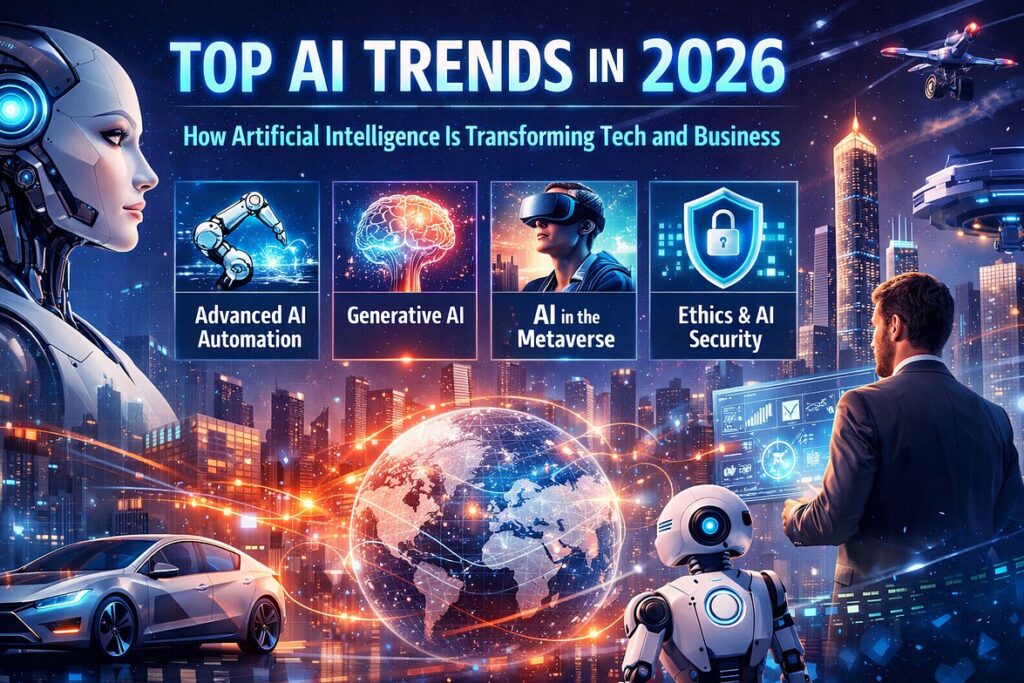
Edge AI is transforming how data is processed by bringing computation closer to the source—whether it’s a smartphone, IoT device, or autonomous vehicle.
Benefits of Edge AI include:
- Reduced latency
- Improved privacy
- Lower bandwidth usage
In 2026, industries such as healthcare, manufacturing, and transportation rely heavily on edge AI for real-time decision-making. This trend is critical for applications where speed and reliability are essential.
6. AI Regulation and Ethical Governance
With the rapid growth of AI, governments and organizations are prioritizing ethical AI development and regulation. In 2026, we see:
- Stricter data privacy laws
- Transparency requirements for AI models
- Increased focus on bias mitigation
Ethical AI is no longer optional—it is a necessity. Companies that prioritize responsible AI practices gain trust, compliance, and competitive advantage.
7. AI-Powered Personalization at Scale
Personalization has reached new heights with AI in 2026. From e-commerce to entertainment, AI systems analyze user behavior to deliver:
- Tailored recommendations
- Customized marketing campaigns
- Personalized learning experiences
This trend enhances user engagement and drives higher conversion rates. Businesses that leverage AI personalization effectively can significantly improve customer satisfaction and loyalty.
8. AI in Healthcare: Revolutionizing Patient Care
AI continues to transform the healthcare industry by improving diagnosis, treatment, and patient outcomes. In 2026, AI is used for:
- Early disease detection
- Drug discovery acceleration
- Virtual health assistants
Healthcare providers benefit from data-driven insights, enabling more accurate and efficient care. AI is not replacing doctors but empowering them with advanced tools.
9. Human-AI Collaboration: Augmented Intelligence
Rather than replacing humans, AI in 2026 focuses on augmenting human capabilities. This concept, known as augmented intelligence, emphasizes collaboration between humans and machines.
Examples include:
- AI-assisted coding tools
- Decision-support systems for executives
- Creative tools for designers and writers
This trend highlights the importance of human creativity combined with machine efficiency, leading to better outcomes across industries.
10. AI in Business Automation: The Rise of Intelligent Enterprises
AI is at the core of business automation in 2026. Companies are becoming intelligent enterprises, where AI drives:
- Workflow automation
- Data analysis
- Strategic decision-making
Automation powered by AI reduces manual tasks, increases efficiency, and allows employees to focus on high-value activities. This trend is reshaping the future of work.
Conclusion: The Future of Artificial Intelligence in 2026 and Beyond
The AI landscape in 2026 is defined by rapid innovation, increased adoption, and deeper integration into everyday life. From agentic AI and multimodal systems to ethical governance and edge computing, these trends are shaping a future where AI is more powerful, accessible, and responsible.
For businesses and individuals alike, staying ahead of these trends is essential. Embracing AI technologies not only enhances productivity but also opens doors to new opportunities in a highly competitive digital world.
As we look toward the future, one thing is clear: Artificial Intelligence is not just a tool—it is a transformative force that will continue to redefine how we live and work.